
Quick answer
The main types of Facebook Groups are public groups, private visible groups, private hidden groups, and purpose-based groups such as local communities, customer communities, professional groups, buy-and-sell groups, event groups, learning groups, and internal team groups.
Facebook Groups are not all the same. Some are open communities where anyone can discover the conversation. Others are private spaces for customers, local members, paid communities, teams, or niche interests.
If you use Facebook Groups for business, this distinction matters. The right post for a public local group may be wrong for a private customer community. A promotional update may be welcome in a marketplace group and unwelcome in a support group.
Contents
Privacy and visibility types
Facebook Group privacy is the first layer to understand. Privacy affects who can discover the group, who can inspect the conversation, and how careful a business should be with context.
Public Facebook Groups
Public groups are discoverable, and group content is generally easier for non-members to inspect. They can be useful for broad awareness, local discovery, and open discussion, but they also require extra care because the audience is wide and moderation expectations may be strict.
Private visible Facebook Groups
Private visible groups can be found in search, but only members can see the full conversation. These groups often work well for customer communities, local communities, professional circles, or moderated discussion spaces.
Private hidden Facebook Groups
Private hidden groups are not generally discoverable by people outside the group. They are usually better for member-only communities, internal teams, paid groups, beta testers, or sensitive topics.
Purpose-based group types
Privacy is only one part of the picture. For business posting, purpose matters even more.
- Local community groups: built around a city, neighborhood, region, or local interest. Businesses should focus on local relevance and rules.
- Customer community groups: owned or supported by a brand for onboarding, product education, feedback, and customer discussion.
- Professional and industry groups: built around a field, role, skill, or business problem. These reward useful expertise and usually reject generic promotion.
- Buy-and-sell groups: built around listings, offers, and transactions. Rules around format, price, location, and frequency matter.
- Event and project groups: organized around a launch, class, trip, campaign, meetup, or short-term initiative.
- Learning and expert groups: organized around teaching, Q&A, coaching, or specialist knowledge.
- Internal team or partner groups: private spaces for employees, collaborators, franchisees, agencies, or partners.
How to choose the right groups for business
Start with audience fit. If the group members are not likely to care about the topic, skip the group.
Read the rules before posting. Many groups limit links, promotions, job posts, real estate posts, marketplace posts, repeated posts, or posts from Pages.
Look at recent conversations. A group may technically allow a topic but still have a culture that rejects certain formats. Match the post to the group type: a customer group may need support context, a local group may need location details, and a professional group may need practical insight before a link.
Facebook Group types compared
| Group type | Best business use | Posting risk | Workflow note |
|---|---|---|---|
| Public group | Broad awareness, local visibility, open discussion | Easy to look promotional or off-topic | Review rules and public context carefully |
| Private visible group | Customer, local, professional, or moderated communities | Members expect relevance and respect for the group culture | Tailor the post to the audience |
| Private hidden group | Paid communities, teams, beta groups, sensitive topics | Posting without context can feel intrusive | Use only when you are clearly part of the community |
| Marketplace-style group | Listings, offers, rentals, local services | Strict format, frequency, and location rules | Track rules and posting status |
| Professional group | Authority building, networking, education | Generic offers are often rejected | Lead with expertise before links |
Where AI Groups Poster fits
AI Groups Poster helps when you already know which groups are relevant and want a more organized workflow.
- Group Collections help save selected groups by campaign, location, topic, audience, or customer segment.
- AI Post Rewriter helps prepare editable variations so different group types do not receive identical wording.
- Schedule Posting helps plan one-time or recurring posting workflows.
- Smart Posting Controls help structure pacing and intervals.
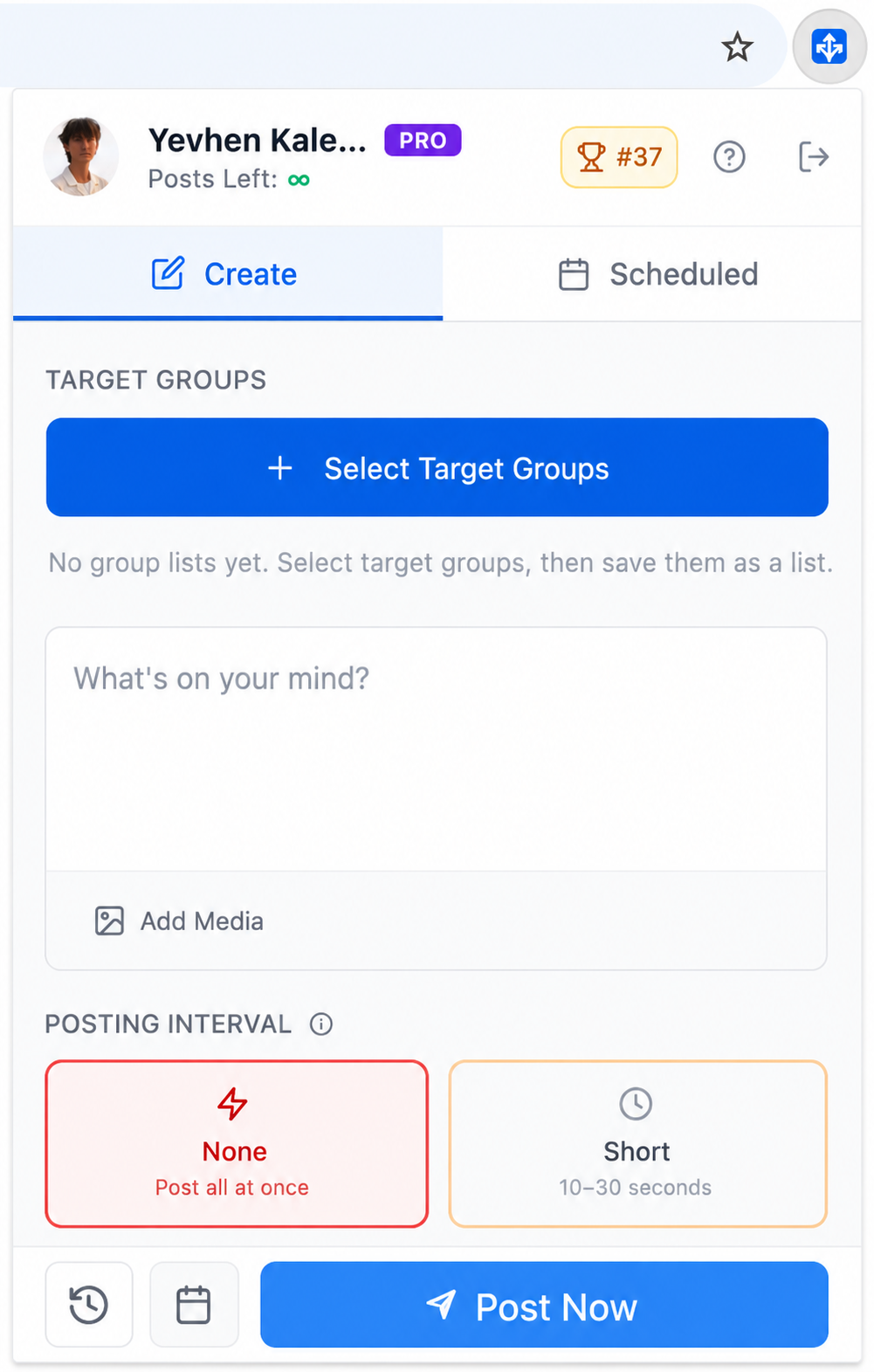
AI Groups Poster does not replace judgment. It does not guarantee reach, approvals, leads, engagement, or account outcomes. It is a workflow tool for preparation, organization, review, and responsible posting controls.
Responsible posting reminder
- Choose groups that are actually relevant to the post.
- Read each group's rules before posting.
- Adjust the post for the group type and audience.
- Review AI-assisted text before using it.
- Skip groups where the post does not fit.
Common questions
Are public Facebook Groups better for business?
Not always. Public groups may offer more visibility, but they can also have broader audiences and stricter moderation. A smaller private group with the right members may be more valuable than a large public group where the post is not relevant.
Should a business create its own Facebook Group?
Creating your own group can work when you can offer ongoing value: support, education, feedback, community, member-only updates, or useful discussion. It is usually a poor fit if the only plan is to publish promotional posts.
Can I post the same thing in every type of group?
Usually no. Different group types need different context. A local group, customer group, professional group, and marketplace group should not always receive the exact same wording.
How should I organize groups I post to regularly?
Keep lists by purpose: local awareness, customer support, professional networking, marketplace listings, events, or partner communication. AI Groups Poster Group Collections can help turn those lists into reusable posting workflows.
Final thoughts
Understanding Facebook Group types helps you avoid treating every community like the same channel. Business posting works better when you choose relevant groups, respect the rules, adjust the message, and follow up like a real participant.
If Facebook group posting becomes a repeated workflow, AI Groups Poster can help organize selected groups, prepare variations, schedule planned routines, and keep review in the process.